Transcript
Announcer:
You’re listening to GLC on ReachMD. This activity is provided by Global Learning Collaborativeand is part of our MinuteCE curriculum.
Prior to beginning the activity, please be sure to review the faculty and commercial support disclosure statements as well as the learning objectives.
Dr. Dolinger:
Anti-integrin therapies offer a targeted gut-selective approach to treating IBD. They help control inflammation while minimizing systemic immunosuppression. So let's break down how these agents work and where they fit in clinical practice today.
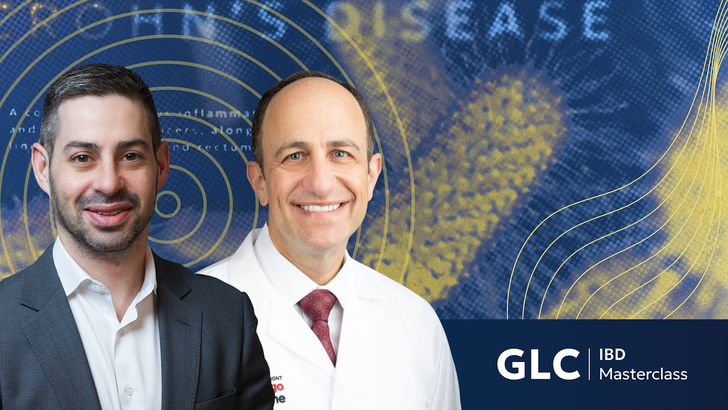
Hello. I'm Dr. Michael Dolinger from the NYU Grossman School of Medicine, and here with me today is Dr. David Rubin from the University of Chicago.
Dr. Rubin:
Hi, Mike.
Dr. Dolinger:
How are you doing?
Dr. Rubin:
I'm good.
Dr. Dolinger:
Okay, let's jump into it. So who do you think is the right IBD patient for anti-integrin therapy? And where do you find them to be effective and safe in your practice?
Dr. Rubin:
Well, the anti-integrin class of therapies is a really interesting one that targets these proteins on lymphocytes that tells the lymphocytes where to go. So the targeting of those proteins called integrins actually inhibits lymphocyte trafficking from within the blood vessels into their target tissues. And when you target alpha 4 beta 7, you're targeting the integrins related to the gut. As you mentioned, a gut-selective strategy.
Vedolizumab is approved by the FDA in the US for moderately to severely active Crohn's disease and for moderately to severely active ulcerative colitis, both induction and maintenance. And because it works on the bowel and in the gut, which includes everything from top to bottom, it doesn't affect our systemic immune system or our immune response in other ways. So it has a really remarkable and very well-described safety profile, which is what makes people very happy about it.
We also have with vedolizumab a head-to-head trial in patients with moderately to severely active ulcerative colitis comparing vedo to adalimumab, an anti-TNF. And at the 1-year endpoint of that trial, patients who received vedolizumab were statistically more likely to achieve clinical remission and endoscopic improvement, or what was called mucosal healing. So it's a very nice therapy, and at least compared to adalimumab, it is a superior option in efficacy for ulcerative colitis.
We also have recently published a description of how to use it in Crohn's. We've known for a while that it works better if you use it earlier in Crohn's, so as the first advanced therapy you might use. And now there's additional data to support its use as a post-op prevention strategy, which I always say in a patient who's had an ileal resection, when you start therapy, that's the earliest time to start therapy, because they've had a surgical remission and now you're preventing recurrence.
So it's a very nice option. People usually think about it for the patient who might be older and has a higher risk for opportunistic infections with other immune strategies, totally reasonable. But also, of course, patients love the idea of using it who are young too.
Now, we also have, in addition to the infusion-based strategies with vedolizumab, a subcutaneous formulation in maintenance that can be used and is administered every 2 weeks. And what we've learned about the pharmacokinetics of subcutaneous administration every 2 weeks is you get a slightly higher drug concentration and a much more even spacing of the therapy over time than the standard peaks and troughs of infusions. So this is a very nice option for many patients.
Where it's not necessarily the right choice is a patient who has extraintestinal problems. By virtue of where it works, if you have an inflammatory arthropathy or an inflammatory skin or eye problem, this is a drug that is not going to work on those problems. And so it's not the right choice if you have a patient who has multiple comorbid inflammatory problems or extraintestinal problems. In those scenarios, one of our other drugs might be a better choice.
Dr. Dolinger:
Okay, so taking your pearls of wisdom for our community gastroenterologists, it sounds like vedolizumab, and by blocking alpha 4 beta 7 and preventing the lymphocyte trafficking to the gut, is really specific to the gut and may be a great therapy for patients who are concerned about immunosuppression and its side effects, and those with multiple comorbidities looking for a great safety profile, and it's very effective in the entire gut, in both ulcerative colitis and Crohn's disease with multiple formulations from IV infusions to injectable options for patients.
Dr. Rubin:
100%. I like that. Go ahead.
Dr. Dolinger:
I was going to say how do you position this in your practice amidst all the available therapies today?
Dr. Rubin:
Well, I think it's a perfect first-line agent to consider in patients with moderate to severe UC or patients who have ulcerative colitis who are not responding to 5-ASA, even if they're a little milder in their disease activity. So it's a great next step, although you can consider other drugs as well in that scenario. This is an obvious choice for many patients.
I also think it's a reasonable option for the patient who is worried about safety. When you explain it to them, I will add a couple pearls about this. One is for people to know that, despite the fact that in the label it says that progressive multifocal leukoencephalopathy is possible, that has not happened with this drug. It's been on the market since 2014 and it was studied for 20 years before that. So we do not worry about that. That was something we saw with a different anti-integrin that was not selective to the gut, so that you can take off your list. But you should be aware that sometimes patients will see that and be nervous and not want to be on the therapy, so we have to advise them properly.
I will also tell you that it's the only drug that has in its label that live virus vaccines can be administered when you're on this therapy, and that's nice to know for certain situations, of course.
And the last thing I'll add is it's a really good foundational therapy to combine with other drugs. As we're moving into this era of combination therapies, this is so safe that we have started looking at using it as a combo strategy with a JAK inhibitor or an anti-TNF or an IL-23. And you might think well who would I do all that with? Well, we're studying it, and there are sponsored trials now exploring that combination strategy, where we might use two drugs to induce remission and then leave them on vedolizumab as a maintenance strategy subsequently.
So this is a really nice safe and effective option for many different types of patients.
Dr. Dolinger:
That's fantastic. And I especially like the part you bring about post-operative Crohn's disease for patients who are in remission, they've had their disease removed and Entyvio is a great option to prevent inflammation from recurring and it’s super safe. I think excellent.
Dr. Rubin:
I think I would just spell one more myth about it. A lot of people say oh it works slow because it's cellular. That's actually been a myth. I think that we need to acknowledge that cellular mechanisms can work as fast as cytokine-based mechanisms.
In an active colitis or a patient with Crohn's, you need to recognize that there's a very rapid and ongoing cellular turnover that's happening. As soon as you put the brakes on that, the bowel can start to heal if it's an effective strategy for that patient. So we should also remember that it does work fairly quickly in many patients.
Dr. Dolinger:
And I believe the separation in curves in the trials from sponsored trials from placebo is not too different or dissimilar from other therapies that people believe work faster.
Dr. Rubin:
That's a really good point. I agree.
Dr. Dolinger:
And so with all this, I think we have a lot of information about vedolizumab that you can take to your practice and implement today. I think this has been a great bite-sized discussion. Our time is up. Thank you, Dr. David Rubin, and thanks, everyone, for listening.
Dr. Rubin:
Thank you for having me.
Announcer:
You have been listening to GLC on ReachMD. This activity is provided by Global Learning Collaborativeand is part of our MinuteCE curriculum.
To receive your free CE credit, or to download this activity, go to ReachMD.com/CME. Thank you for listening.

 Global Learning Collaborative (GLC) designates this activity for 2.0 contact hour(s)/0.2 CEUs of pharmacy contact hour(s).
  Global Learning Collaborative (GLC) has been authorized by the American Academy of PAs (AAPA) to award AAPA Category 1 CME credit(s) for activities planned in accordance with AAPA CME Criteria. This activity is designated for 2.0 AAPA Category 1 CME credit(s). Approval is valid until 6/1/27. PAs should claim only the credit commensurate with the extent of their participation in the activity.